I confess to being something of a Sudoku tragic. I play it over lunch and whenever the television gets boring. There are really only two ways to solve a square: add the one number that is the only logical fit, or take away every number that cannot possibly go there. Most of the time you do both, until only one answer is left standing.
Every buyer looking at your business is playing the same game. They simply do not tell you the rules.
› The haystack, and what gets taken away
Even if someone has tapped you on the shoulder and specifically seeks your business; all buyers start with a metaphorical haystack. Every business in a sector, in a region, at a price is inside that haystack. Then the process of elimination starts. Each element that does not fit removes another name from the haystack, and the haystack shrinks, and never gets bigger.
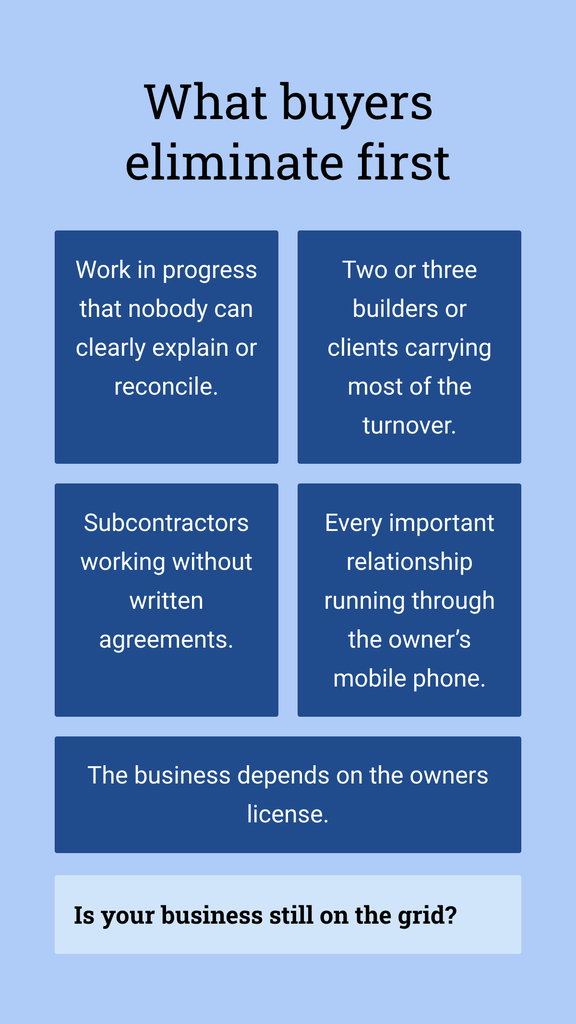
In building and construction, there are a few eliminations I frequently see:
- Work in progress that nobody can clearly explain or reconcile.
- Two or three builders or clients carrying most of the turnover.
- Subcontractors working without written agreements.
- Every important relationship running through the owner’s mobile phone.
- The business depends on the owners license.
None of these makes a business bad. Each one, however, is a number that does not fit in the square, and a buyer will either walk away or discount the price to cover the risk.
So here is the uncomfortable question. When a buyer has finished taking away, would your business still be on the grid?
› The eliminating is getting faster
Earlier this week a small operator in building and construction rang us. When I asked how he had found us, his answer was not a referral, a directory or a search engine. He had asked ChatGPT.
Of every valuer, broker and accountant in Queensland, the machine added what it knew, took away whoever did not fit the criteria, and was left with one name. If a machine can find the right valuer in seconds, imagine how quickly a buyer’s adviser can find a reason to walk away.
› Solve your own grid first
A proper valuation follows exactly the same logic. I add what I can establish: the financial and non-financial records; what I see on site, the people, the contracts, and real market sales information. Then I take away what cannot be true: the one-off items, the personal expenses run through the business, the add-backs that will not survive a buyer’s scrutiny. The result is invariably the figure that fits every row, every column and every box.
That is why a valuation prepared from an armchair so often fails. It is a Sudoku attempted with half the grid missing. A proper one does something more useful still: it shows you which squares are empty while there is still time to fill them, before a buyer finds them for you.
Arthur Conan Doyle gave Sherlock Holmes the line that every Sudoku player, and every honest valuer, lives by:
“When you have eliminated the impossible, whatever remains, however improbable, must be the truth.”
Sherlock Holmes, The Sign of the Four (1890)
› Consider this
I know this industry. Somebody may already be adding and taking away: a buyer, their adviser, or autonomous AI scripts are asking and answering questions about your business. When they have finished, will your business be the number that is left, or one of the many already eliminated?
If you would like to know how your business looks once the impossible has been taken away, a confidential fifteen-minute conversation costs you nothing. Call Kevin Lovewell directly on 1300 551 757.
~ Kevin Lovewell