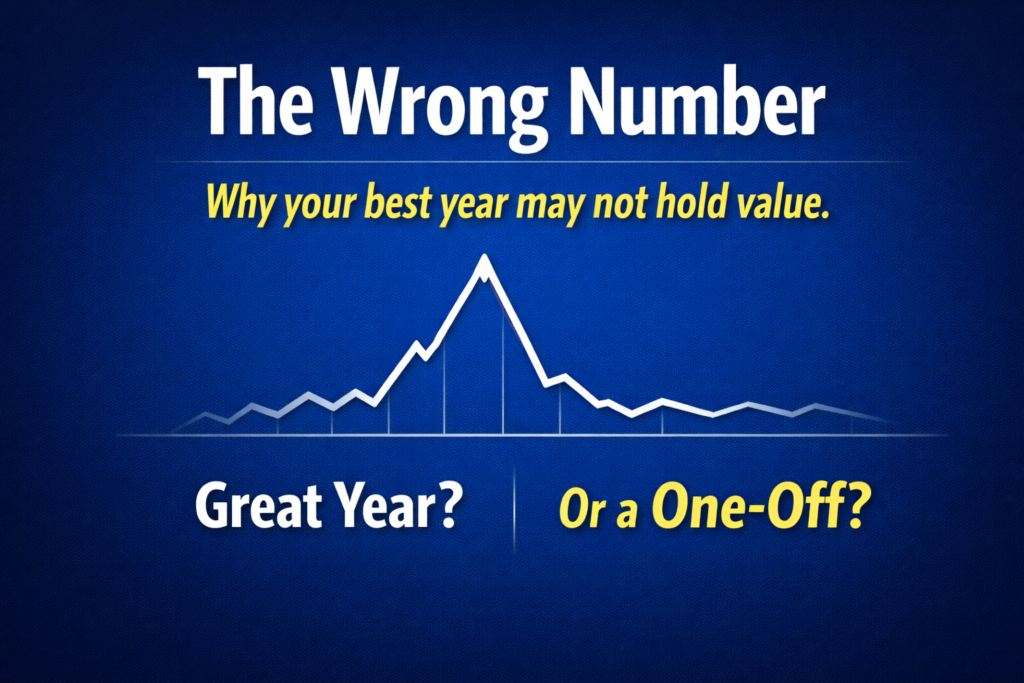
Why buyers ignore your best year and focus on your trend
Most business owners rely on the wrong number.
They focus on the best year.
Buyers do not.
They look at the trend and more importantly, they ask a different question:
What changed, and can it be repeated?
The problem with a single result
A strong year creates confidence. That is understandable.
But a single result is not a pattern. It is a point in time.
Value does not attach to a moment.
It attaches to outcomes that can be sustained.
This is where the gap often sits between expectation and reality.
An owner sees performance.
A buyer tests durability.
What sits behind the numbers
When a result looks strong, the next step is not to accept it.
It is to understand it.
In practice, that is where the detail starts to matter.
Margins may have been compressed to win work.
Costs may have been deferred.
Work may have been accepted simply to maintain activity.
None of these are unusual. Most businesses experience them at some point.
But they raise a question:
Are these conditions part of the business model, or a response to pressure?
Because if the result depends on conditions that cannot be sustained, it becomes difficult to rely on.
What buyers are actually assessing
A buyer is not purchasing last year’s outcome.
They are purchasing a set of earnings that must hold under change, pressure, and different ownership.
That requires a different lens.
They are looking for:
- consistency in performance
- evidence of repeatability
- margins that reflect commercial reality
- cost structures that are maintained, not deferred
- results that do not depend on the current owner
If those elements are present, the numbers tend to support themselves.
If they are not, the discussion shifts quickly.
Where deals become difficult
Most transactions do not become complex because of the headline number.
They become complex because the explanation behind the number does not hold.
When that happens, the conversation changes.
It moves from:
“What did the business make?”
to:
“Why did it make it and will it happen again?”
If that question cannot be answered clearly and logically, the position becomes vulnerable.
This is often where negotiation begins.
The practical point
If the trend does not make sense, neither will the valuation.
That is not a theoretical observation. It is how buyers approach risk.
Unusual patterns do not disappear in a transaction.
They become the focus of it.
The earlier those patterns are understood, the more control an owner retains over the outcome.
What to ask instead
The question “What is my business worth?” still matters.
But on its own, it is incomplete.
The more useful question is:
What is my business worth — and why?
The answer will not sit in a single year.
It will sit in the trend, and in whether that trend can be explained, supported, and repeated.
Conclusion
A strong year is easy to point to.
A consistent trend is harder to challenge.
Buyers know the difference.
If you want to understand value, start there.
If you are considering a future sale, I would be pleased to discuss how a buyer is likely to interpret the trend in your business and what that means in practice.