
Business owners often assume buyers focus first on profit.
In practice, experienced buyers rarely start there.
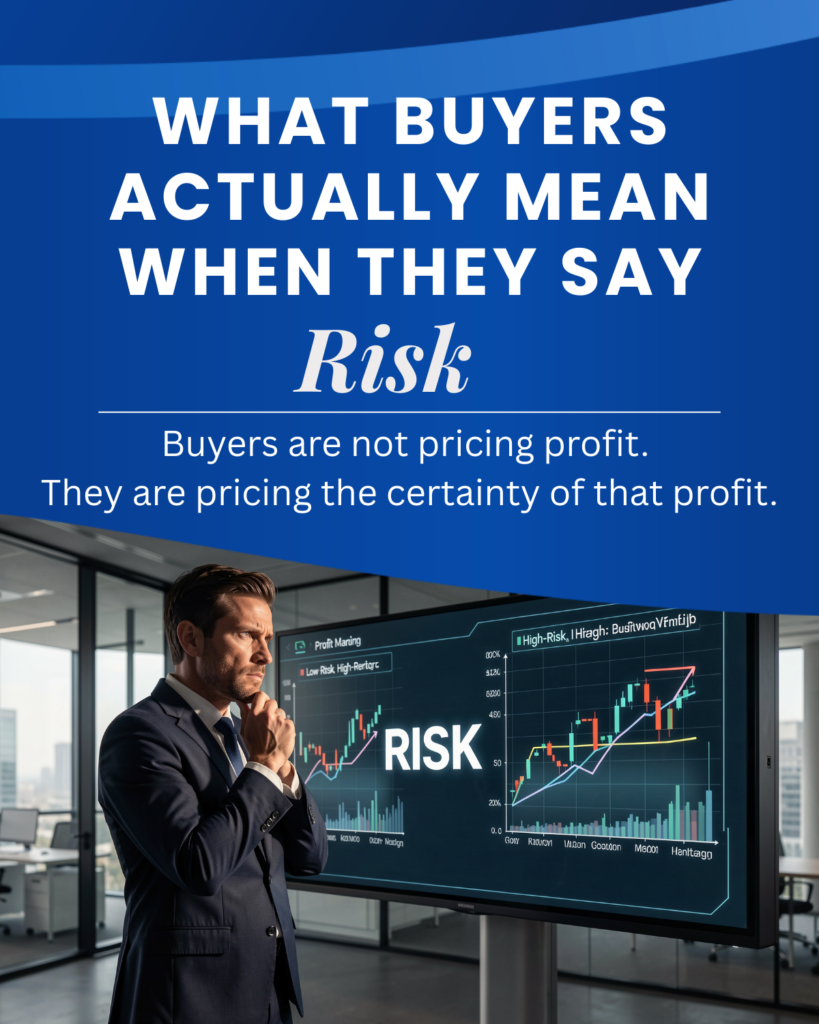
The first question is almost always about risk.
Not risk in the abstract sense.
Risk in the practical sense of whether those earnings will survive once ownership changes.
Two businesses can produce identical profits today and still attract very different valuations.
The difference is rarely the accounting result.
It is the risk attached to those earnings.
Risk Is Really About Sustainability
When buyers talk about risk, they are usually asking a very simple question:
Will this business continue to perform without the current owner?
That question immediately brings several issues into focus.
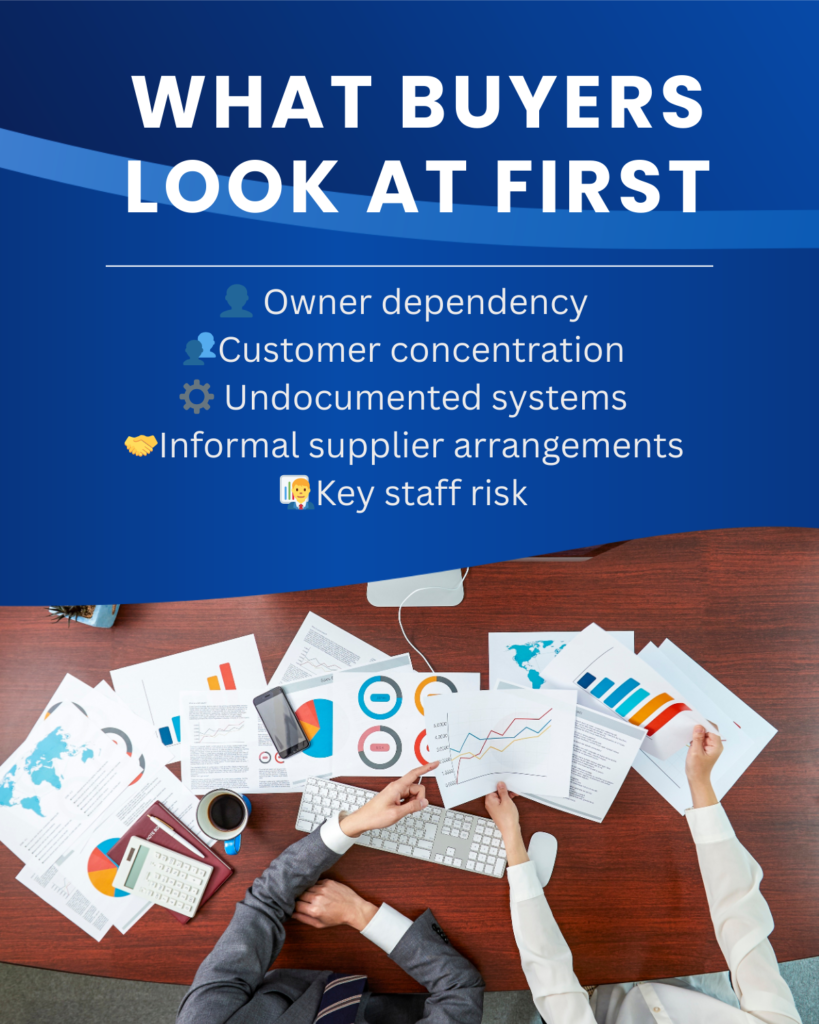
Customer concentration.
Key staff dependency.
Informal supplier arrangements.
Personal relationships driving revenue.
Operational knowledge held by only one or two people.
None of these may appear in the profit and loss statement.
Yet they can have a profound impact on value.
A business producing strong profits today may still be considered risky if the buyer believes those profits depend heavily on factors that cannot easily be transferred.
Where Buyers Actually Look First
In many transactions, experienced buyers spend surprisingly little time analysing historical profits in the early stages.
Instead they look for signals about the structure of the business.
Questions tend to focus on matters such as:
- How diversified is the customer base?
- How dependent is the business on the current owner?
- Are there documented systems and processes?
- How stable is the management team?
- What would happen if one key person left?
These questions are not accounting questions.
They are risk questions.
And the answers often shape the valuation long before the financial modelling begins.
Profit Can Be Real — Yet Still Be Risky
It is entirely possible for a business to produce genuine profits while still being viewed as high risk.
This often occurs in owner-led businesses where:
- relationships drive revenue
- knowledge sits with a single individual
- systems exist informally rather than structurally.
From the owner’s perspective the business may feel stable and predictable.
From a buyer’s perspective the same situation may appear fragile.
That difference in perspective is where valuation gaps often emerge.
Why This Matters for Business Owners
Owners sometimes believe that improving profit alone will maximise value.
Profit certainly matters.
But value is ultimately determined by how durable those earnings appear to an incoming owner.
Reducing dependency on individuals, strengthening systems, and diversifying revenue sources often has a greater impact on valuation than simply increasing revenue.
Buyers are not only buying earnings.
They are buying confidence those earnings will continue.
A Practical Observation
One of the more interesting aspects of business valuation is that the factors which reduce risk are often the same factors that improve the day-to-day running of the business.
- Clear processes.
- Strong teams.
- Diverse customers.
- Documented systems.
These things do not always show up in financial statements.
But they frequently determine whether a business appears stable and transferable or fragile and owner-dependent.
And that perception can have a significant impact on value.