Every business owner confronts the same dilemma during uncertain economic times: how do we increase prices when the market is exhibiting the same fear, uncertainty, and doubt that we feel as costs continue to climb relentlessly?
The conventional wisdom suggests freezing prices during a recession is the safe option, perhaps even reducing them to maintain market share. This approach often proves more damaging than the economic headwinds themselves. Drawing upon my “Valuers” toolbox and the authoritative analysis provided by Porter’s Five Forces, I propose that there are three critical criteria that should govern pricing decisions, regardless of market conditions.
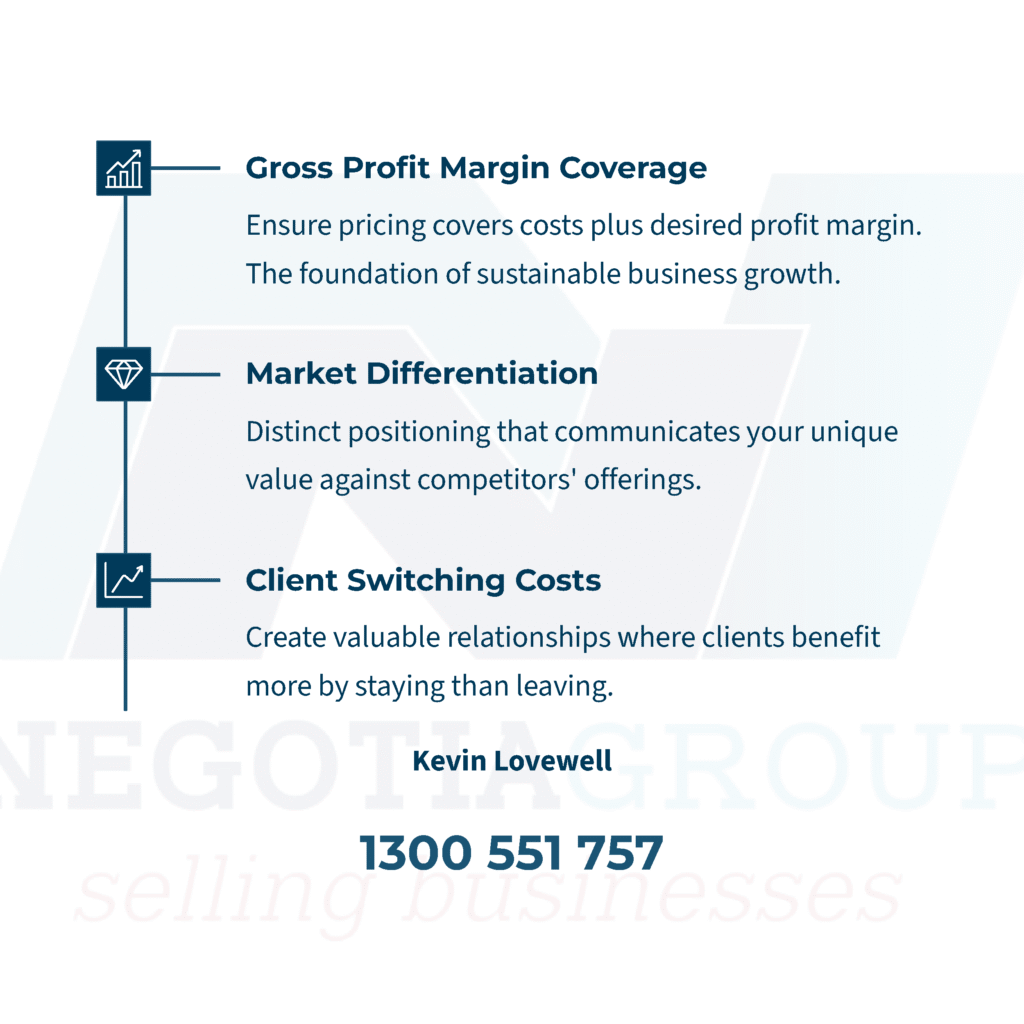
First Criterion: Your Gross Profit Margin Must Cover Rising Fixed Costs
Your gross profit margin represents the buffer between revenue generation and your fixed cost base. During a recession, this margin becomes even more critical because fixed costs rarely pause in response to economic uncertainty.
The reality facing most businesses today is that operational costs continue rising regardless of economic sentiment. Technology subscriptions, professional services, regulatory compliance, insurance premiums, and facility costs all demand attention. These are not discretionary expenses but essential infrastructure for maintaining professional standards and competitive capability.
The mathematics are unforgiving. You cannot expect to earn the same gross billings as last year and maintain the same profitability when your cost base has fundamentally shifted. If you are not passing these increases through to clients, you are absorbing them. The question becomes: how far can you absorb them before profitability erodes beyond recovery?
Fixed costs are increasing rapidly across all sectors. If you are not thinking of increasing prices, you are essentially subsidising your clients’ operations from your own diminishing margins. This is neither sustainable nor strategically sound.
Second Criterion: Market Differentiation Determines Pricing Power
Porter’s analysis of competitive rivalry reveals a fundamental truth: businesses with genuine differentiation possess pricing flexibility that commoditised providers do not. The intensity of competition within your market segment directly influences your ability to maintain pricing integrity during challenging periods.
Differentiation extends beyond product features. It encompasses your expertise, professional credentials, track record, and the unique value you deliver to client relationships. At Negotia Group, we are witnessing “value erosion” through our analysis work; Valuers who adhere to International Valuation Standards (IVS) use a business assessment methodology that can identify the entrepreneurs who create a clear separation from competitors who may be offering superficially similar services.
Ask yourself: what specific advantages do you possess that competitors cannot easily replicate? How clearly can you articulate these advantages to prospective clients? If you operate in a commoditised market where clients view all providers as interchangeable, your pricing power diminishes accordingly. However, genuine differentiation through specialised knowledge, superior service delivery, or unique market positioning enables you to command premium pricing even during economic downturns.
Third Criterion: Client Switching Costs Provide Pricing Resilience
The strength of your client relationships and the practical difficulties clients face in switching to alternative providers represent your third strategic consideration. Porter’s framework examines buyer power, which encompasses not only clients’ negotiating strength but also their realistic alternatives.
Professional service businesses often benefit from substantial switching costs, though these may not be immediately apparent. When clients have invested time educating you about their business, established reporting relationships with your team, and integrated your services into their operational processes, the cost of switching extends far beyond monetary considerations.
During a recession, clients become more price-sensitive, yet they simultaneously become more risk-averse. The disruption associated with switching professional service providers represents a risk many clients prefer to avoid during uncertain times. This dynamic creates opportunities for businesses with strong client relationships to maintain pricing whilst competitors engage in destructive price competition.
Evaluate your client portfolio honestly. Which relationships have developed genuine switching costs? Where and How have you become integral to clients’ operations rather than merely transactional? These relationships provide the foundation for pricing stability during economic challenges.
The Strategic Decision
These three criteria work in concert to create a framework for pricing decisions that transcends short-term market sentiment. The businesses that emerge stronger from economic downturns maintain their strategic focus whilst competitors retreat into reactive thinking.
Remember, there will always be an outcome from your pricing decisions. That outcome may not align with your initial expectations, but this should not deter you from making necessary adjustments. The market intelligence you gather from implementing considered price increases will inform your future decisions and strengthen your competitive position.
The alternative approach of reducing prices to stimulate demand during a recession often creates a downward spiral that proves difficult to reverse. Once you train the market to expect discounted pricing, re-establishing premium rates becomes exponentially more challenging.
Review your current pricing structure against these three criteria. Calculate your true gross profit margins, assess your market differentiation honestly, and evaluate the strength of your client relationships. The data will guide your decisions more effectively than market sentiment or competitive anxiety.
For professional guidance in evaluating your business’s pricing strategy and competitive position, contact Kevin Lovewell directly on 1300 551 757.