
Over four decades in my profession of accounting – including valuing businesses, I have observed a curious consistency. Whether valuing a manufacturing concern, a professional services firm, or a family-owned enterprise referred by a solicitor for matrimonial or succession matters, certain patterns emerge with remarkable reliability. Solicitors often tell me their clients express surprise when discovering that businesses with similar annual revenues trade at vastly different valuations. The explanation invariably lies not in operational complexity but in business fundamentals. An owner who has built systems, developed strategic assets, and created sustainable competitive advantage commands premium value. One who remains primarily a skilled technician does not. This distinction applies universally across every sector we value, which is precisely why solicitors engaged in commercial disputes, family law matters, or business transitions find that understanding these principles proves essential for their clients.
My journey through business valuation has been guided and influenced by several exceptional thinkers, each fine-tuning specific aspects of business behaviour yet united in their quest to understand and predict how businesses truly succeed or fail. I always encourage business people to read these thoughts.
Carl Gould illuminates the predictable crises all businesses encounter. Michael Gerber explains the transformation from technician to entrepreneur. Michael Porter provides the important framework for sustainable competitive advantage. Together with insights from Peter Drucker, Larry Greiner, and Siimon Reynolds, these authors form a tapestry of understanding that, when synthesised, reveals the mechanics of business value creation.
I consider myself a student of business and business theory, continuously learning by watching enterprises succeed and fail. You need not be an academic theorist to benefit from these insights, but understanding how these ideas interact proves invaluable when building a business that outlasts crises. What follows draws from these sources to explain why some businesses thrive through adversity whilst others falter.
The Seven Crisis Points Every Business Encounters
Imagine an athletics track with seven broad rubber bands strung across it at intervals, sturdy barriers anchored between poles. When you begin your race, you run smoothly until you hit that first barrier. Then one of three outcomes follows: you break through and continue stronger, you are forced back but remain upright to try again, or you are eliminated entirely.
This athletics track metaphor, which I have adopted from Carl Gould’s work, represents seven predictable crisis points every business confronts: confidence, autonomy, control, management, identity, incumbency, and legacy. Each stage both represents a fundamental shift in how the business must operate and how the owner must think. Every stage begins with relative calm before entering turbulence and crisis. The business that survives does so by breaking through, not by retreating.
What proves most significant about Gould’s framework is this: the future of any organisation is fashioned less by external market forces than by internal deficiencies in business thinking. Market conditions change, competitors emerge, and customer preferences shift. These factors are given. Yet businesses fail at these identifiable and predictable crisis points because owners fail to evolve in their thinking and capabilities. As Henry Ford observed, “A man who knows a job sees so much more to be done than he has done, that he is always pressing forward and never gives up an instant of thought to how good and how efficient he is. Thinking always ahead, thinking always of trying to do more, brings a state of mind in which nothing is impossible.”
The Three Transformations Required
Technical competence alone will not build a business nor create value. Michael Gerber articulated this brilliantly in his examination of what he termed the E-Myth. Most business owners begin because they possess particular skill. They are talented solicitors, skilled accountants, capable tradespeople. They believe technical excellence translates to business success. It does not.
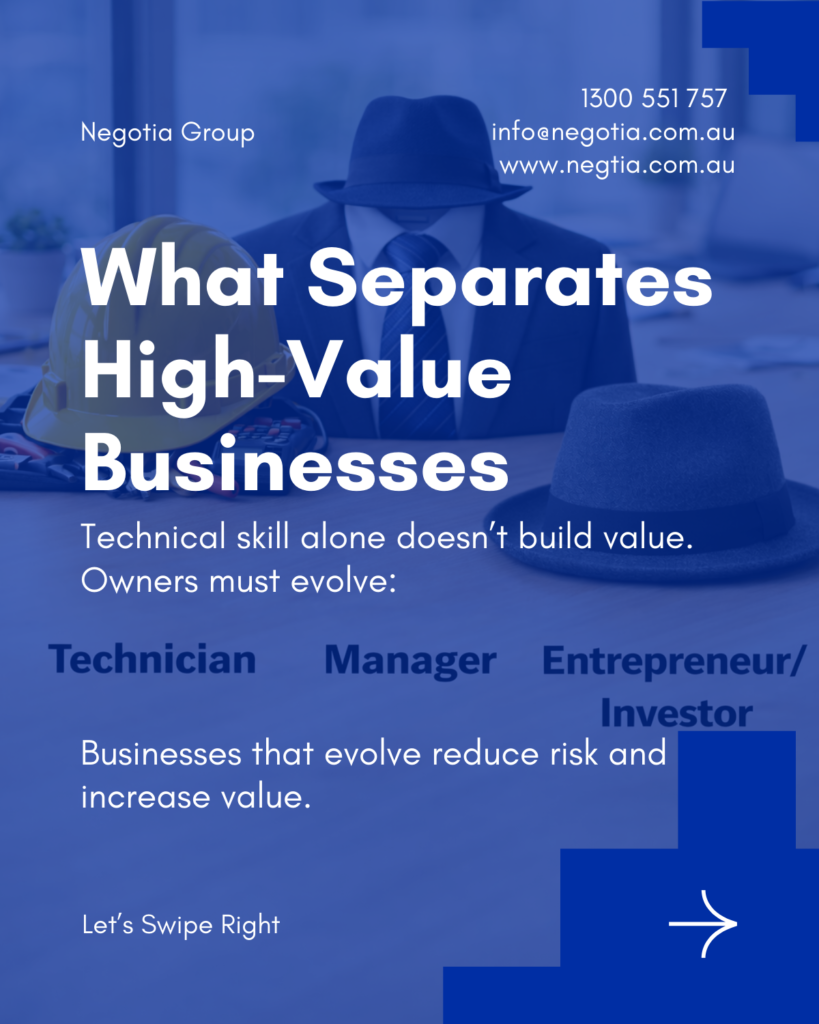
To build valuable businesses, owners must wear three distinct hats.
- The first is that of the technician, the person who knows how to deliver the service. This represents the least important role, though most owners spend the majority of their time here.
- The second is the manager, responsible for allocating scarce resources and building systems that allow the business to function without constant intervention.
- The third, most important, is the investor and entrepreneur who establishes rules, sets goals, and pursues value creation with discipline.
The technician will always find employment working for the person who knows why, not merely how. Moving from technician to manager to entrepreneur represents precisely the elements of personal transformation required to break through those crisis barriers. Each crisis demands evolution. Each barrier tests whether you have developed the capabilities needed for the next stage.
Why Risk Diminishes When You Step Forward
Business owners frequently become paralysed by uncertainty, perceiving the unknown as inherently risky. Yet here lies the paradox: whilst you cannot know what will happen in your business future, the certainty accompanying inertia carries far greater risk. The certainty of knowing what will happen represents the real danger.
Those who succeed understand which risks create value and which merely create chaos. They act with self-belief, knowing each action represents an essential step toward their goal. There exists a critical ingredient distinguishing those who break through barriers from those who retreat: courage earned through forward movement. Every step forward increases your reservoir of courage; every retreating step draws from it.
You cannot lessen risk by reducing effort. Conversely, you reduce risk by increasing effort. Committed action creates information, builds capabilities, and generates momentum. Hesitation creates none of these. As William Ernest Henley wrote in Invictus: “I am the master of my fate, I am the captain of my soul.”
Failure, rejection, and setbacks must come first. If you are not failing, you are not growing.
Building Value Through Strategic Assets
Understanding crisis points and personal evolution represents necessary but incomplete preparation for building lasting value. Businesses commanding premium valuations possess what Michael Porter termed sustainable competitive advantage, deriving from ownership of strategic assets that create barriers to imitation.
Through our valuation work at Negotia, we have developed the Strategic Position Matrix, identifying five distinct strategic positions businesses occupy and how to move up that scale. These range from innovation-based advantage at the strongest level to pure resource coordination at the weakest. Businesses emerging from crisis the strongest use each survival point as an opportunity to move up this hierarchy, building defendable assets rather than simply working harder with standard resources.
This requires constant scrutiny for opportunities and recognition of sources of change before competitors identify them. Peter Drucker advocated what he called “planned abandonment,” the deliberate decision to release what no longer serves the business’s future in favour of what creates value tomorrow. Each crisis point successfully navigated provides the platform for building these strategic assets. Each barrier broken through strengthens the business precisely because it forces evolution in both the owner and the organisation.
Clarity of Purpose Above All Else
Siimon Reynolds concluded his examination of why people fail with this observation: “The simple truth is this: the more clarity you have about what you want in every area of your life, the more likely you are to get what you want.” Just as a magnifying glass focuses the sun’s rays to burn paper in moments, the focused mind brings concentrated power to business decisions.
It is not intelligence that makes great businesses. It is clarity of purpose. Harvey Firestone stated, “I have never found that pay and pay alone would either bring together or hold together good people. It was the game itself.” Business represents the best game available, but only when you understand what winning means to you.
We have developed many business strategies using frameworks that focus on the underlying phase present in the organisation to promote the growth desired. We call that “Business Planning on a Postcard” because simplicity and clarity matter more than elaborate documentation.
The Path Forward
Every business confronts multiple and sequential crisis. These barriers await regardless of industry, size, or ambition. The question is not whether you encounter them, but whether you break through. That outcome depends on your willingness to evolve from technician to manager to entrepreneur, to step forward when uncertainty counsels retreat, and to build strategic assets creating lasting value.
The businesses we value most highly understand this reality and prepare accordingly. They recognise that crisis creates opportunity for those positioned to exploit it, and that resilience built through survived hardship becomes the foundation for future growth.
I encourage you to explore the works of these advanced thinkers. Each author provides depth and nuance that rewards study. As a student of business, I continue finding new insights in their thinking, and I suspect you will as well.
If you are seeking to understand the value in your business today and what it could become tomorrow, or if you need guidance navigating strategic challenges, we are here to provide it. Our valuation work adheres to International Valuation Standards, and our strategic guidance draws from extensive experience helping businesses build lasting value through crisis and growth alike.
Contact Kevin Lovewell directly on 1300 551 757 to discuss your business’s strategic position and value creation opportunities.
~ Kevin Lovewell
References if you are interested.
Gerber, M.E. (1995) The E-Myth Revisited: Why Most Small Businesses Don’t Work and What to Do About It. New York: HarperCollins.
Gould, C.L. (2010) The Seven Stages of Small Business Success: What You Need to Know to Get from Start-up to Seven Figures in Sales. Charleston: Keynote Publishing.
Greiner, L.E. (1972) ‘Evolution and Revolution as Organizations Grow’, Harvard Business Review, 50(4), pp. 37-46.
Lovewell, K. (2024) The Strategic Position Matrix: A Framework for Business Valuation and Competitive Analysis. Beachmere: Negotia Group. Available at: https://www.negotia.com.au/business-value-the-strategic-position-matrix/
Porter, M.E. (1980) Competitive Strategy: Techniques for Analyzing Industries and Competitors. New York: Free Press.
Reynolds, S. (2010) Why People Fail: The 16 Obstacles to Success and How You Can Overcome Them. Sydney: Penguin Group Australia.