Four Strategic Routes from Resource Integration to Asset-Based Differentiation
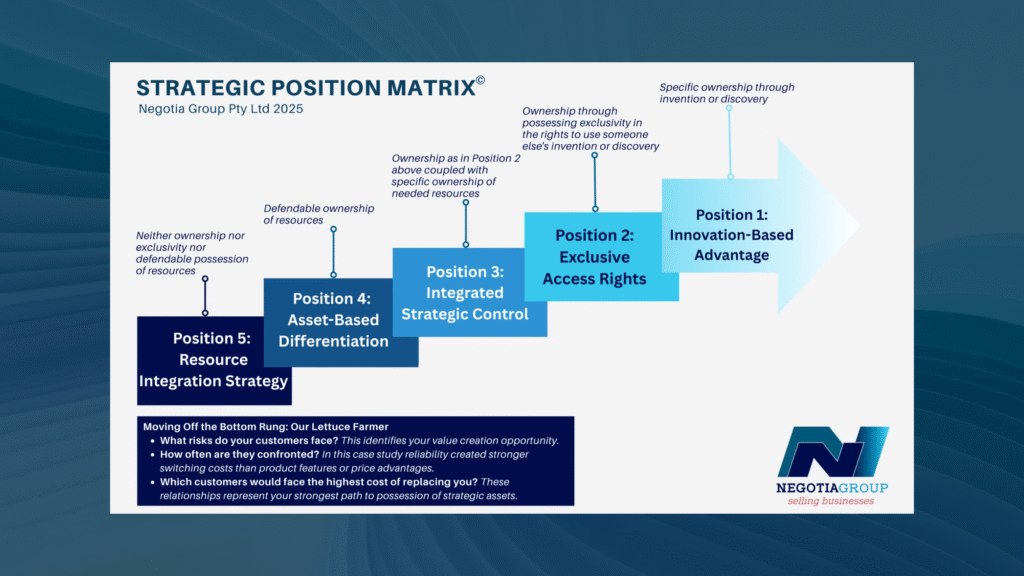
Following last week’s examination of supply reliability as a pathway to competitive advantage, I received questions about “other ways” and “alternative approaches” to moving off the bottom rung of my Strategic Position Matrix. Today, I examine four distinct strategic pathways that transform standard resource coordination into defendable asset ownership.
Through valuation work applying International Valuation Standards, there are significant short-term and medium-term pathways available for building defendable assets. The following four represent basic approaches – not necessarily applicable or cheap for every business – but they are relatively common value builders I observe. The critical insight lies not in finding the “best” pathway, but in identifying which approaches align with your specific business circumstances and market opportunities, following that pathway until you know for sure you are on the right track.
Understanding the Strategic Leap
Before examining these pathways, let us clarify what Position 4 achievement requires. Asset-Based Differentiation means owning something competitors cannot easily replicate. These assets create barriers to competitive entry, generate customer switching costs, and establish defendable market positions through accumulated strategic advantages.
The critical leap from Position 5 to Position 4 transforms your business from coordinating standard resources to owning competitive barriers. Whilst our previous lettuce farmer example demonstrated supply reliability, numerous alternative pathways exist for different business types and market conditions.
Pathway One: Strategic Location Control
Any service-based business can secure Position 4 by purchasing/leasing premises in strategically advantageous locations. Consider a suburban accounting practice that purchases premises close to a growing residential area. This creates immediate competitive barriers:
The Strategic Asset: Prime location ownership rather than rental dependency
The Competitive Barrier: Competitors must either locate outside the community (reducing client accessibility) or negotiate secondary rental arrangements, creating cost and convenience disadvantages.
The Defendable Advantage: Physical proximity that cannot be replicated without significant capital investment
Valuation Impact: Location-based assets compound over time as community growth increases both property values and customer accessibility advantages. The business owns an appreciating strategic asset whilst competitors face increasing rental costs.
Application Principle: Strategic location control works particularly well for businesses where customer convenience drives purchasing decisions – professional services, retail operations, healthcare practices, and personal services.
Pathway Two: Specialised Capability Development
Trades-based businesses establish Position 4 through systematic investment in continuing professional development and specialised certifications. Consider a hydraulic repair business that invests in advanced manufacturer certifications or tooling:
The Strategic Asset: Technical capabilities requiring expensive training, specialised diagnostic equipment, and manufacturer certification.
The Competitive Barrier: These qualifications demand significant time and capital investment that generalists cannot economically justify.
The Defendable Advantage: Exclusive access to high-value contracts that competitors cannot legally or practically service
Strategic Development: A business that systematically acquires certifications for German hydraulic systems, Italian precision pumps, and American industrial compressors. Each certification created a separate competitive moat for specific market segments.
Application Principle: Specialised capability development works effectively for technical trades, professional services, and any business where regulatory or manufacturer requirements create natural barriers to competitive entry.
Pathway Three: Exclusive Supply Relationships
Building materials suppliers and product-dependent businesses establish Position 4 through exclusive distribution arrangements. Consider a wholesale timber supplier that negotiates exclusive regional distribution rights for premium European timber products:
The Strategic Asset: Contractual exclusivity that prevents competitor access regardless of their operational efficiency.
The Competitive Barrier: Competitors cannot access these products through any alternative channels within the defined territory.
The Defendable Advantage: Product differentiation that transcends price competition and creates customer dependency
Strategic Implementation: The supplier committed to minimum purchase volumes and marketing investments in exchange for territorial exclusivity. This transformed a commodity business into a speciality operation with premium pricing power.
Application Principle: Exclusive supply relationships work particularly well for distribution businesses, retail operations, and service providers who can commit to volume or marketing requirements that smaller competitors cannot match.
Pathway Four: Accumulated Market Intelligence
Service businesses establish Position 4 through systematic documentation and institutional knowledge development. Consider a commercial cleaning operation that systematically documented facility specifications, mitigates regulatory and commercial risk through maintenance schedules, and client preferences over many years:
The Strategic Asset: Institutional knowledge and documented client intelligence that competitors would require years to replicate.
The Competitive Barrier: Deep understanding of client needs, facility requirements, and operational preferences that new competitors cannot access without high start-up risk/cost.
The Defendable Advantage: Operational efficiency and client satisfaction levels based on accumulated knowledge rather than generic service delivery.
Strategic Development: Creation of detailed facility profiles, maintenance histories, and preference databases for each client. This institutional knowledge enables premium service delivery that competitors could not match without “buying” similar information.
Application Principle: Accumulated market intelligence works effectively for any business where customer knowledge, operational understanding, or market insights create service advantages that time and systematic documentation can compound.
Selecting Your Strategic Pathway
Each pathway transforms standard resource coordination into defendable asset ownership, but through different strategic approaches suited to specific business circumstances:
Assessment Framework:
- Location Control: Requires capital investment but provides immediate competitive barriers
- Specialised Capability: Demands time and training investment but creates ongoing qualification advantages
- Exclusive Relationships: Needs commitment and volume guarantees but establishes market access barriers
- Market Intelligence: Requires systematic documentation but builds compound knowledge advantages
Implementation Considerations
SME,s must be realistic in their preparation, planning and actually systematic in their activity:
Capital Requirements: Location control and specialised capability development require significant upfront investment, whilst exclusive relationships and market intelligence demand ongoing operational commitments.
Time Horizons: Market intelligence and capability development create assets gradually over time, whilst location control and exclusive relationships can establish competitive barriers more immediately.
Defendability Strength: All four pathways create Position 4 assets, but with different vulnerability profiles to competitive erosion or circumvention.
The Strategic Reality
Moving from Position 5 to Position 4 requires deliberate asset development rather than operational improvement alone. The pathway you choose matters less than the systematic commitment to building something defendable that competitors cannot easily replicate.
Remember that competitive advantage stems from strategic choices about asset development, not just efficient resource coordination.
Next week: How businesses progress from Position 4 to Position 3 – controlling multiple strategic assets simultaneously through Integrated Strategic Control.
For professional guidance in selecting and developing the optimal strategic pathway for your business circumstances, contact Kevin Lovewell directly on 1300 551 757.
About the Author
Kevin Lovewell is a professional business valuer and business broker who adheres to International Valuation Standards (IVS). Through NEGOTIAGROUP, Kevin provides business valuations, strategic assessments, and guidance to SME owners, family lawyers, solicitors, and accountants.
Contact Information
📞 1300 551 757
🌐 www.negotia.com.au
📧 in**@*********om.au