Even if you’re selling something everyone else already sells?
For one small business, it was. They didn’t invent something new. They didn’t cut costs. They didn’t even scale. They simply made 30 perfect deliveries in a row — and became impossible to replace.
How a subtle mind shift initiated a long-term business relationship, transforming a commodity product into a premium offer — and how you can apply the same four steps to create real switching costs, customer loyalty, and pricing power from day one.
It’s not about what you sell. It’s about the risk you remove.
My valuation assignments frequently identify common traits exhibited by small enterprises, such as owners who are the busiest but lowest paid workers; where the capacity to build a business investment is consistently underestimated. This blog is designed to highlight why the challenge lies not in operational capability, but in thinking … strategically. Startups can and do transform standard business practices into competitive barriers.
I want to prove how well this works with another very practical question: “How exactly do I create value as a start-up?”.
Let’s examine this progression through a startup hydroponic business that transformed itself from competing on price to premium positioning.
This case study comes from an actual valuation assignment where we assisted a business build its plan and gain micro-business investment.
The Strategic Distinction
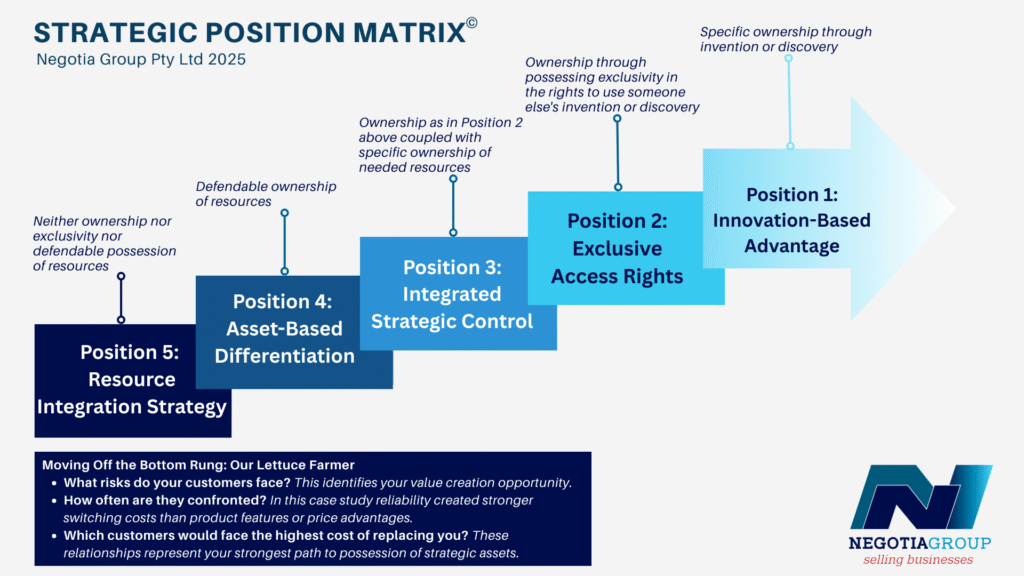
The Start up or Bottom Rung – How to coordinate stock-standard resources better than competitors. Micro businesses at startup are limited to the same tools and resources as everyone else, and what’s worse… you are almost invisible, competing mainly on price and operational efficiency. This why you need Resource Integration Strategies to propel you one step forward.
The Second Rung – Means you own something competitors cannot easily replicate. This “ownership” creates the first competitive barrier or hurdle in your value building quest. One such strategy is creating high customer switching costs
Case Study: The Lettuce Farm’s Strategic Transformation
Consider a family lettuce farming operation facing typical startup challenges: limited labour, seasonal demand, and intense price competition from larger agricultural operations. Most small farms respond by trying to increase volume or cut costs – classic Bottom Rung (Position 5) thinking.
Instead, this farmer thought of a different pathway.
Rather than competing on volume, they focused on one critical customer irritant or problem: Supply Reliability. Retailers face significant business disruption when fresh produce suppliers fail to deliver. Empty shelves mean lost sales and operational chaos.
The Strategic Shift: The farm committed to delivering exactly three boxes of lettuce to a favored retail customers every Monday, Wednesday, and Friday for 90 days. This represented a commitment to making 30 sequential no fuss deliveries, on time and it established their commitment to absolute reliability.
The Results: After 90 days of perfect (preferential)performance, the customer had developed significant switching costs. Finding alternative suppliers meant accepting the uncertainty and doubt that had once been present with previous suppliers. The risks (cost of switching) had within 90 days exceeded any potential price savings offered by competitors.
The Four-Step Strategic Framework: Moving off the bottom rung.
Step One: Identify Customer Risk: What is the biggest risk you can mitigate? i.e when others fail to deliver? Understanding customers vulnerability reveals your value creation opportunity.
Step Two: Eliminate That Risk: Consistently Focus resources on removing customer risk rather than maximising your own volume. In this story, the client served fewer customers better rather than many customers inconsistently.
Step Three: Build Switching Costs: Customer confidence develops or falters… In this example ninety days of reliability created stronger barriers than promises or price agreements.
Step Four: Price for Value Not Cost: Once switching costs develop, price your services to reflect risk reduction value, not just production costs plus margin.
Universal Application
These principles work across industries:
- Professional Services: Never miss deadlines and anticipate client needs
- Trade Services: Arrive precisely when promised and solve problems before they become emergencies
- Retail Operations: Guarantee product availability when customers need it
- Manufacturing: Create delivery reliability that eliminates customer inventory risks
The Strategic Reality
Small businesses possess inherent advantages that help climb the Strategic Position Matrix or Ladder because they can give person to person loyalty and reliability larger competitors cannot economically deliver. The lettuce farm charged premium rates because they eliminated supply risk, not because their product was fundamentally different.
Key Insight: “Thank you Kevin, that single line in your valuation was a game-changer. Now we don’t have to worry about selling our crops because they are promised before we even plant” – Isaac Dayao
Small operations that can eliminate customer risk will consistently outperform larger competitors that prioritise volume efficiency over relationship value.
Evaluating your strategic position:
- What risks do your customers face when you fail? This identifies your value creation opportunity.
- How consistently do you eliminate these risks? Reliability created stronger switching costs than product features or price advantages.
- Which customers would face the highest cost of replacing you? These relationships represent your strongest path to possession of strategic assets.
The Strategic Choice
Moving from the bottom rung up just one step (Position 5 to Position 4) requires building something defendable rather than simply working harder with standard resources. This is just one example where a focus on creating competitive barriers from day one started putting together a valuable business investment.
Remember: low level competitive advantage stems from strategic choices, not operational scale.
Next week, climbing further from Position 4 to position 3 in our Strategic Position Matrix.
For professional guidance in assessing your business’s strategic position and developing competitive advantages, contact Kevin Lovewell directly on 1300 551 757.