Why Queensland’s construction boom keeps breaking the trades that build it
Kevin Lovewell, Negotia Group. Figures as at October 2026.
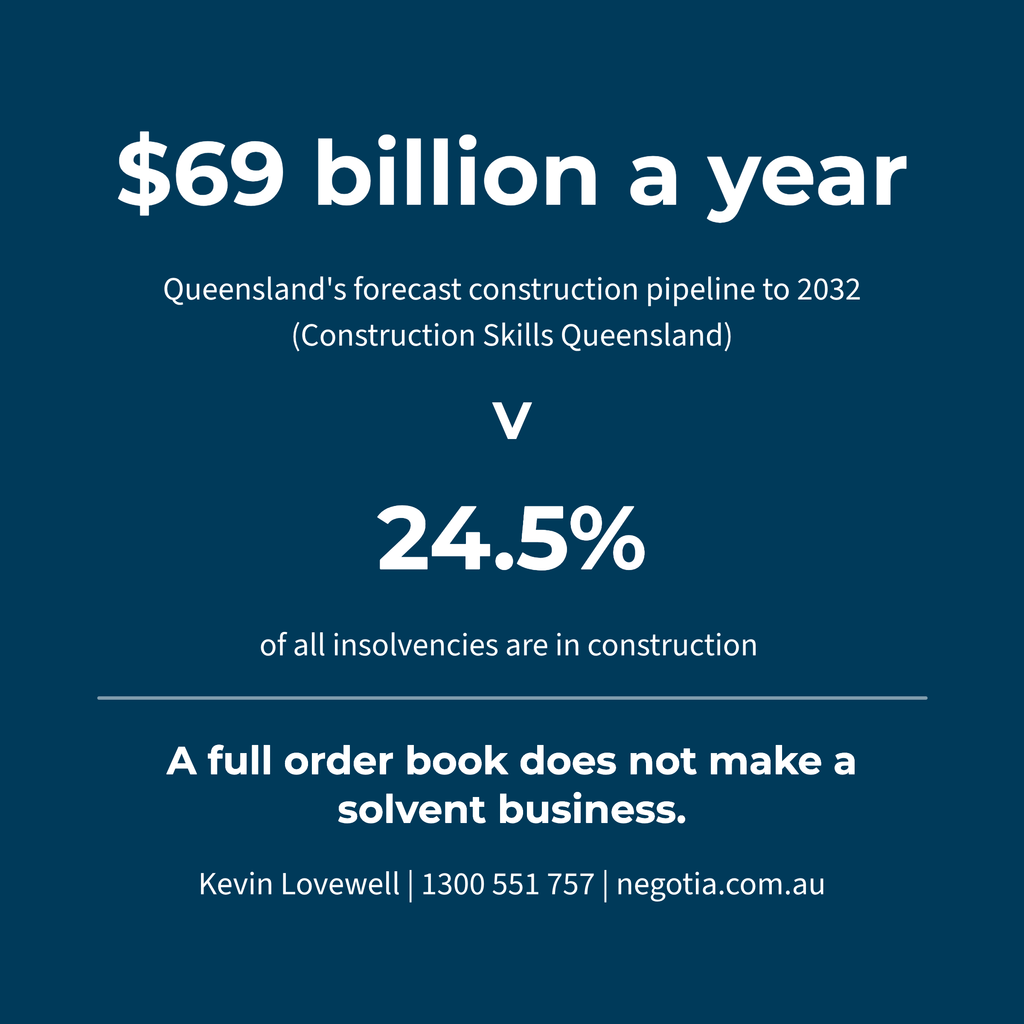
Queensland is in the longest construction run most of us will see in a working life. Construction Skills Queensland forecasts the state’s pipeline will average $69 billion a year, peaking at $75 billion in 2027/28. Yet construction remains the largest single source of business failure in the country. Nationally, it accounted for 24.5 per cent of all insolvencies in 2025-26.
Government can point out that construction insolvencies fell in 2025-26, the first annual decline in five years. They did. But construction’s share of all failures has sat between 24 and 28 per cent every year since 2021-22. The count moved. The pattern did not.
A full order book does not make a solvent business. Demand is not the problem. How the work is priced, funded and reported is.
It does not start overnight
No builder or trade contractor goes broke on the day the administrator arrives. The appointment is the last entry in a sequence that usually runs for a year or more, and every step leaves a mark in the accounts: a job quoted on last year’s prices, a margin that disappears, a progress claim paid late, a tax debt treated as working capital, a balance sheet stretched to stay inside the licence turnover cap.
In my files, the sub-trades carry the most risk, and plumbers, electricians and bricklayers sit at the top of that list. That is an observation from my own work, not a published statistic and my rationale is not hard to defend. Sub-trades are paid last. They carry the least capital. They quote fixed rates against labour and materials costs that move up every month. Their retentions sit in someone else’s bank account. And they are exposed to every builder above them in the chain: one head contractor’s failure will take several trades with it.
The national data points the same way. In the year to June 2025, firms with fewer than 20 full-time staff made up 76 per cent of construction insolvencies.
Numbers built to pass the test
For QBCC licensees, the warning signs are written into a document they lodge every year. The Minimum Financial Requirements (MFR) demand net tangible assets of at least $0, a current ratio of at least 1:1, and enough working capital to support the licensed turnover. They must be met at all times, not only on the date the report is submitted.
When a business is sliding, the temptation is to make the report pass rather than fix the business. The process is familiar to anyone who reviews construction accounts:
- work in progress valued at what was claimed, not at what will be recovered;
- disputed variations booked as current receivables;
- director and related-party loans reclassified between current and non-current to rescue the current ratio;
- plant revalued upward;
- supplier and subcontractor invoices held back past balance date;
- tax debt left out, or pushed into long-term liabilities.
Some of this is error. Some of it is fabricated evidence, prepared to keep a licence alive. The QBCC draws its line at knowledge: giving it information you know to be false or misleading about meeting the MFR is grounds for regulatory action against the person who gave it.
In valuation work I ask two standing questions of every set of accounts. Have any personal or non-business expenses been included? Has any trading income been earned but not shown? For a builder’s MFR report, I turn them around. Has any liability been incurred but not shown? Has any asset been shown at more than it will realise?
The damage is not only regulatory. A builder who dresses the balance sheet to pass the test misleads himself first.
The electricians’ exception
Electricians sit outside this test. In Queensland, electrical contracting is licensed by the Electrical Safety Office under the Electrical Safety Act 2002, not by the QBCC. An electrical contractor licence requires a qualified technical person, a qualified business person, public liability insurance of at least $5 million and consumer protection insurance of at least $50,000. There is no balance-sheet test equivalent to the MFR, unless the electrician also holds a QBCC contractor licence.
Perhaps that is also why electricians seem to avoid the fixed-price dilemma. I offer that as a hypothesis, not a finding. An electrician with no turnover cap tied to net tangible assets, in a trade long used to pricing by the hour, by the point and on schedules of rates, has less reason to chase volume through fixed-price work. If that is right, it also explains why electricians still rank high in my files: their exposure comes from the builders above them in the chain, not from their own pricing.
The accountant who looks away
Every one of those dressed balance sheets passed across an accountant’s desk. Some accountants know what they are signing and sign it anyway, on the argument that if they refuse, the client will take the books elsewhere.
That is not an ethical dilemma. It is a commercial preference dressed up as one, and I have no time for it. The Code of Ethics that binds members of the professional accounting bodies, APES 110, does not make integrity conditional on keeping the fee. An accountant must not knowingly be associated with information that is materially false or misleading. Dependence on a client’s fees is a recognised self-interest threat, to be managed, not pleaded as an excuse.
The regulator takes the same view. In 2020 the QBCC banned 15 accountants indefinitely from providing financial information on behalf of any licensed builder, for lodging false, incorrect or misleading MFR information. It has banned others since.
To the builder reading this: an accountant who signs whatever you hand over is not protecting you. That firm is helping you trade on a balance sheet that is not real, until an appointment makes the real one public.
Disclosure: I am a member of the Institute of Public Accountants and bound by the same Code. Judge the argument, not the credential.
The labour squeeze
Construction Skills Queensland forecasts a peak shortfall of up to 35,000 workers in 2027-28. WT’s Brisbane 2032 modelling puts it higher, at up to 46,000 in 2028-29, on the assumptions that every forecast project proceeds and no worker leaves the industry. On either number, small operators lose people to large projects offering three years of continuity and enterprise agreement rates.
Since 1 January 2026, that pull is a market force rather than a mandated wage premium: the Queensland Procurement Policy 2026 permanently removed Best Practice Industry Conditions from government construction work. For the small builder, the result is the same. You cannot outbid a stadium. You can:
- price the scarcity of labour into every quote;
- keep a core crew on terms that make them stay;
- choose work that fits the crew you have, not the crew you wish you had;
- train apprentices as tomorrow’s capacity;
- decline work you cannot staff.
The job you cannot staff is the job that sends you broke.
Stop signing fixed prices on stale estimates
A fixed price in a rising market hands all the cost risk to the party least able to carry it. The alternatives are well known: rise-and-fall clauses, provisional sums for volatile items, schedules of rates for uncertain scope, short quote validity periods, and variations documented and enforced every time. For trades, the same discipline applies to the subcontracts you accept from builders, not only to the quotes you issue.
In domestic work, a price adjustment clause must comply with the QBCC Act. The contract must carry a warning, and a brief explanation of how the price can change, in a prominent position on the first page of the schedule. The District Court of Queensland has struck down a clause that fell short. Have it drafted properly, once, and use it every time.
You can’t run a business with a hammer in your hand
Most builders and trades moved from the tools into running a business without anyone teaching them how to run that business. At a minimum, an owner should know the margin gained on each job, the cash position each week, what the balance sheet says, and what the MFR report certifies on their behalf. That means monthly management accounts, including cashflow and job costing efficiency; not annual accounts prepared nine months after June 30th. You need a bookkeeper or part-time CFO matched to the size of the business; and an accountant prepared to deliver bad news on time and accurate.
The boom will reward the operators who know their numbers. The rest will be part of next year’s insolvency – 24.5 per cent.