The Profit Paradox
When the numbers look extraordinary, a good valuer asks why…. because sometimes the answer is hard to stomach.
The numbers were remarkable. Revenue was strong, Gross profit seemed under control and fixed costs had fallen; business profitability had reached levels never previously achieved. The outgoing general manager, who also held a shareholding, was understandably pleased. His payout, structured around that period of exceptional earnings, was substantial.
He negotiated his exit, shook hands, collected his cheque, and left. But what remained was rather more obscure and puzzling.
Customer complaints moved from a trickle to a flood. Reports of product malfunctions, insufficient this, missing that; all of which had been hidden became a daily occurrence. Containers where seals failed and contents were compromised stood on pallets covering the car park. Cancelled repeat orders and client exodus was swift and deadly.
Equipment was breaking down; Settings and calibrations that routine maintenance programmes were designed to catch or prevent slowed down all productivity. And then, the legal letters appeared; with quantified and costly damage claims. A business that had appeared, on paper, to be performing at the peak of its short history was, in reality, standing on the edge of a cliff that its departing manager had spent the preceding period carefully concealing.
This is not a hypothetical scenario. It is a case I have been directly involved in. And it is the most instructive illustration I know of why a business valuation based solely on reported earnings is not a valuation at all. It is an invitation to be defrauded.
What He Actually Did
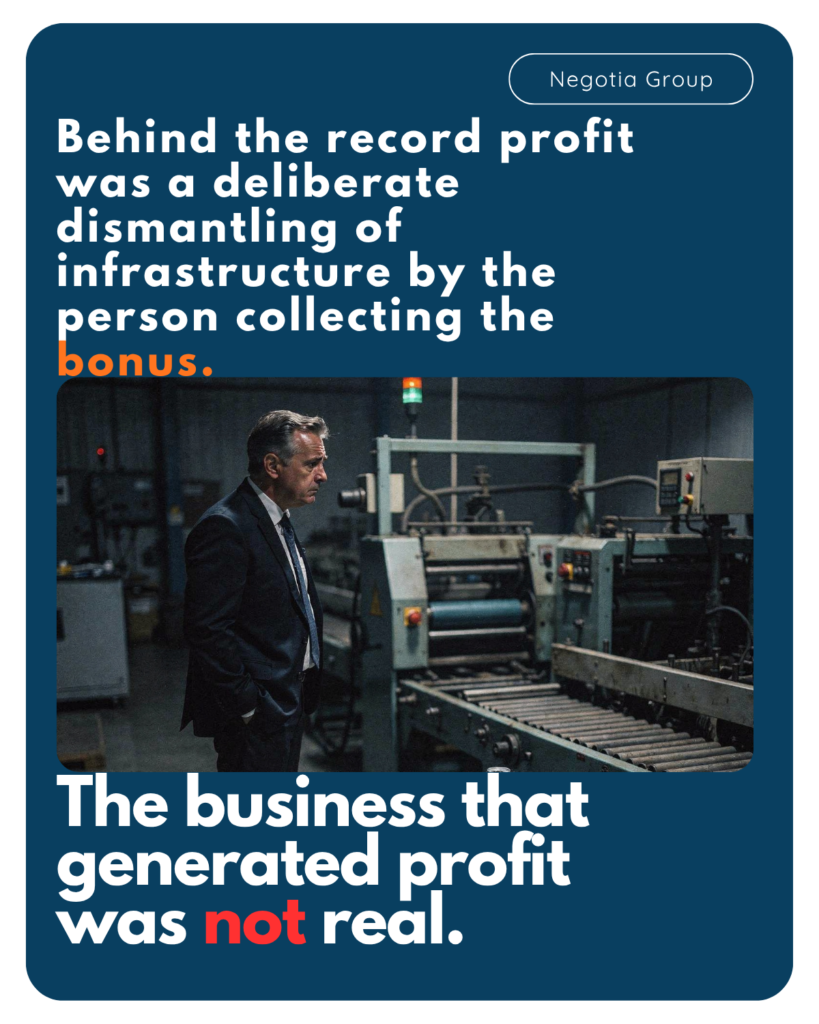
The mechanism was neither complicated nor subtle, once you understood it. The exiting manager had negotiated, quite deliberately, that his personal payout would be calculated by reference to the profitability of the business during the period leading to his departure. He therefore set about engineering that profitability with a single objective: to maximise the number, regardless of what actually occurred to the health of the enterprise.
Repairs and maintenance were stopped. Not reduced, stopped. Equipment that required servicing was kept running until it could no longer function. The maintenance programme, which existed precisely to prevent the kind of catastrophic failures that followed, was abandoned as a cost item that reduced his payout. All training and on-boarding new staff also ceased.
Quality control was eliminated with equal deliberateness. The controls that governed the recipes in the products manufactured, were sidelined. Gross profit margins were inflated by reducing the quality of inputs that the product specification demanded. The container seals, the ingredients, the consistency of the product that customers had been purchasing for years: all of it was quietly and deliberately compromised in the interest of a short-term earnings figure.
The profitability was real. The business that generated it was not.
Why the Numbers Lied and What a Proper Valuation Reveals
Here is what a competent, independently conducted valuation under International Valuation Standards would have identified had one been commissioned at the right moment.
Normalised earnings are not the same as reported earnings. The International Valuation Standards require an assessment of the earnings a business can sustainably generate under competent management, operating the business as a going concern, with all the costs that a prudent operator would incur. That standard exists precisely because reported profitability can be manipulated. Sustainable profitability cannot.
When a valuer examines a business and observes that repairs and maintenance expenditure has fallen to zero, that is not a sign of efficiency. It is a waving red flag. When Key Performance Indicators (KPI’s) stop being measured and certain line items simply disappear from the accounts, a professional will ask why?
When gross profit margins improve dramatically but the product or service offering appears unchanged, the correct professional response is not to accept the improvement at face value. It is to ask, with considerable precision, how that improvement was achieved and whether it is capable of being sustained.
A thorough valuation did also flag and identify the extent of all deferred maintenance liabilities — the cost of rectifying equipment failures that had been run down significantly reducing serviceable life as well as product quality.
We worked to identify and quantify exposure — the significantly increased risk of complaints, returns, and damage claims arising from product liability.
Not only did our adjusted and normalised earnings reflect the costs that a legitimate operator would have incurred, we revealed and explained the new contingent liabilities accumulating silently on the horizon.
The adjusted earnings figure was materially lower. The risk to future earnings was materially higher. And the payout to the departing manager? The business owners are seeking recovery of all that, through the courts.
The Language for What This Actually Is
I want to be direct about something. What I have described above is not aggressive accounting. It is not creative cost management. It is not the kind of short-term thinking that well-meaning business owners sometimes engage in without fully understanding the consequences.
What this general manager did was deliberate, calculated, and designed to transfer value from the owners and future stakeholders of the business into his own pocket. He knew that the maintenance was necessary and he stopped it. He knew that the quality controls existed for a reason and he removed them. He knew that the profitability he was generating was not real and he accepted his payout on the basis of it regardless.
That is defalcation. It is a misappropriation of value that belongs to others, achieved through the deliberate manipulation of financial information. And it is more common in business sale transactions than most people are comfortable acknowledging. It is not a story that is unique or exaggerated.
What Business Owners and Their Advisers Must Understand
If you are a business owner preparing to sell, an accountant advising a client on an acquisition, or a solicitor acting in a transaction involving a business with a departing principal, the lesson here is not academic.
A profit and loss statement is a historical document. It records what happened. It does not, without careful analysis, tell you why it happened, whether it is repeatable, or what obligations the business has accumulated in the course of generating it. A business valuation worthy of the name goes behind the numbers. It asks whether the costs that should have been incurred were incurred. It identifies what has been deferred, what has been eliminated, and what liabilities are sitting off the balance sheet waiting to be recognised.
A seller who has manipulated earnings to inflate a payout is, in many cases, relying on a valuation process that does not look closely enough. The defence against that manipulation is not suspicion. It is rigour. It is the application of International Valuation Standards by a valuer who understands that the most important question in any assessment is not what the numbers say. It is what the numbers are hiding.
If you are acquiring a business, selling one, or advising a client who is doing either, I urge caution – trust but verify! And if you want a valuation that goes beyond the surface of the accounts and asks the questions that protect your interests, I would welcome the conversation.
Contact Kevin Lovewell directly on 1300 551 757.
The earlier a proper assessment is commissioned, the better positioned you are to see what is actually there.