Last week, I wrote about a principle that surprises many business owners:
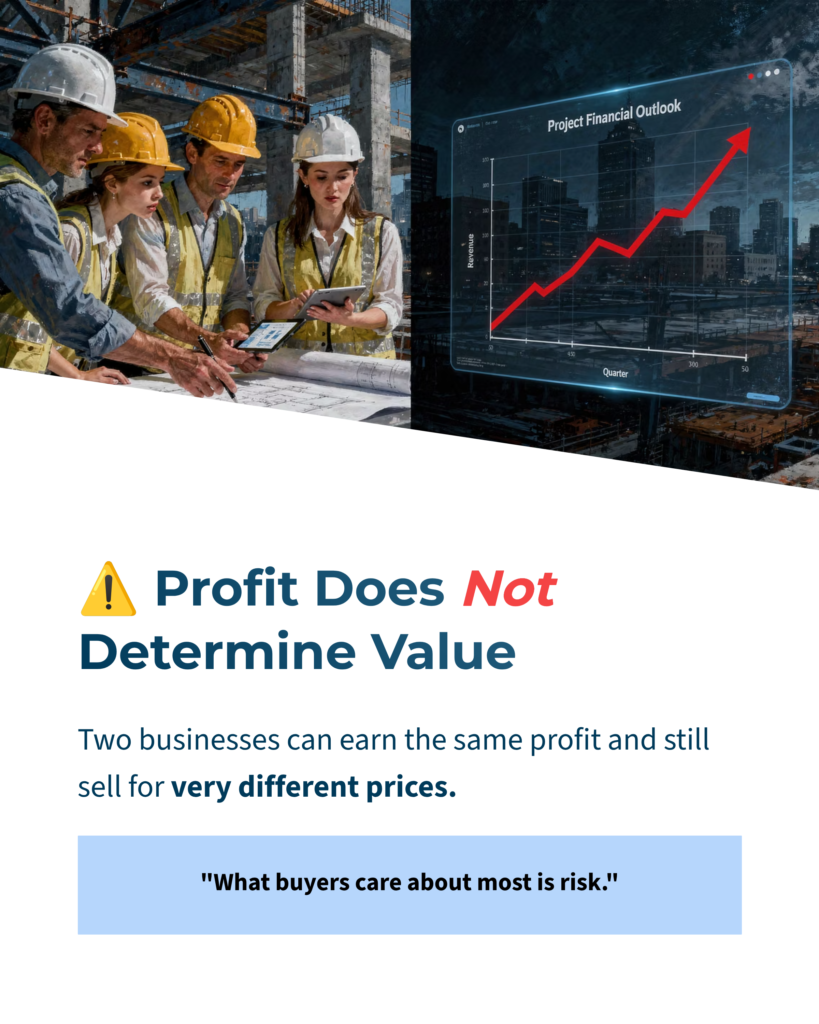
Profit does not equal value.
A business can show strong profits and still attract a modest price in the market. Conversely, a business with modest profits may sell for a significant multiple.
The difference usually comes down to risk.
Buyers do not purchase historical profit.
They purchase the rights to future earnings and that opinion of future “profits” must survive risk questions that drive uncertainty.
That is why risk often matters more than profit.
Profit Is Only Half the Equation
Most business valuations ultimately come back to a simple structure:
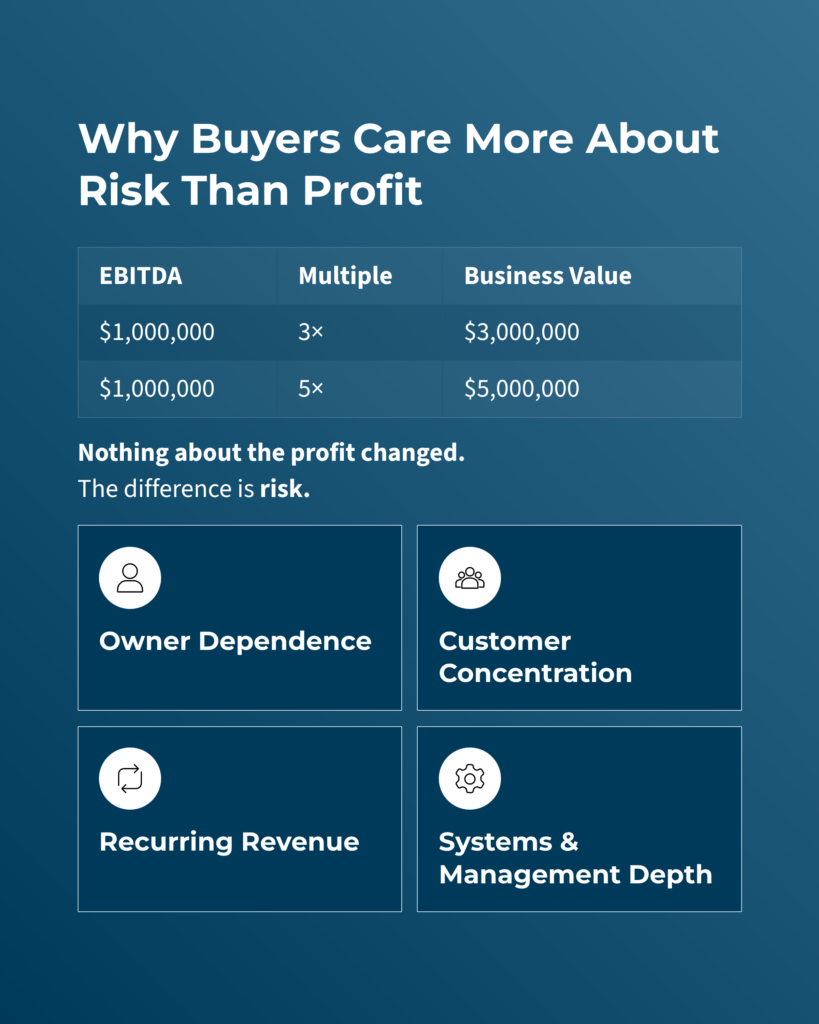
EBITDA × Multiple = Enterprise Value
Owners tend to focus on the first half of that formula — EBITDA.
But the multiple is just as important to the buyer.
The multiple is simply the market’s shorthand for the risk rate applied to those earnings. If a buyer requires a 25% return to justify the risk of a business, the mathematics implies a multiple of roughly four times earnings. If the perceived risk increases and the required return rises to 33%, the implied multiple falls to around three times earnings.
Nothing about the profit (EBITDA) has changed.
The change is entirely concerned with the risk assessment applied to those profits.
How Risk Changes the Multiple
When valuers assess a business, the process is not simply to identify profit and apply an industry multiple.
A disciplined valuation process builds a risk profile of the enterprise first.
We are asking questions such as:
- Is this business typical for its sector?
- Is it more stable than average?
- Or is it materially more fragile than it appears?
If the business is more stable than the market norm, the risk rate decreases and the multiple increases.
If the business carries greater uncertainty, the risk rate rises and the multiple contracts.
This is why two businesses with identical EBITDA can produce very different valuation outcomes.
One may have stable contracts, diversified customers, and systems that operate beyond the owner.
The other may rely on one individual and a single project.
The profits may be identical.
The risk is not.
The Hidden Risk Buyers See Immediately
One of the most common issues encountered in practice is owner dependence.
Many businesses appear profitable on paper but are heavily reliant on the founder’s relationships, knowledge, or personal reputation.
Buyers recognise this risk quickly.
If revenue is tied to one individual, the earnings may not be fully transferable after a sale. In those circumstances, the buyer is not purchasing a stable enterprise. They are purchasing a fragile income stream.
That uncertainty feeds directly into the risk rate.
In family law valuations, this issue often overlaps with the distinction between enterprise goodwill and personal goodwill, where income generated by an individual’s skill or reputation may not be transferable to a purchaser.
Buyers instinctively recognise this risk long before it appears in a valuation report.
The Practical Takeaway
For business owners considering succession, the practical point is straightforward.
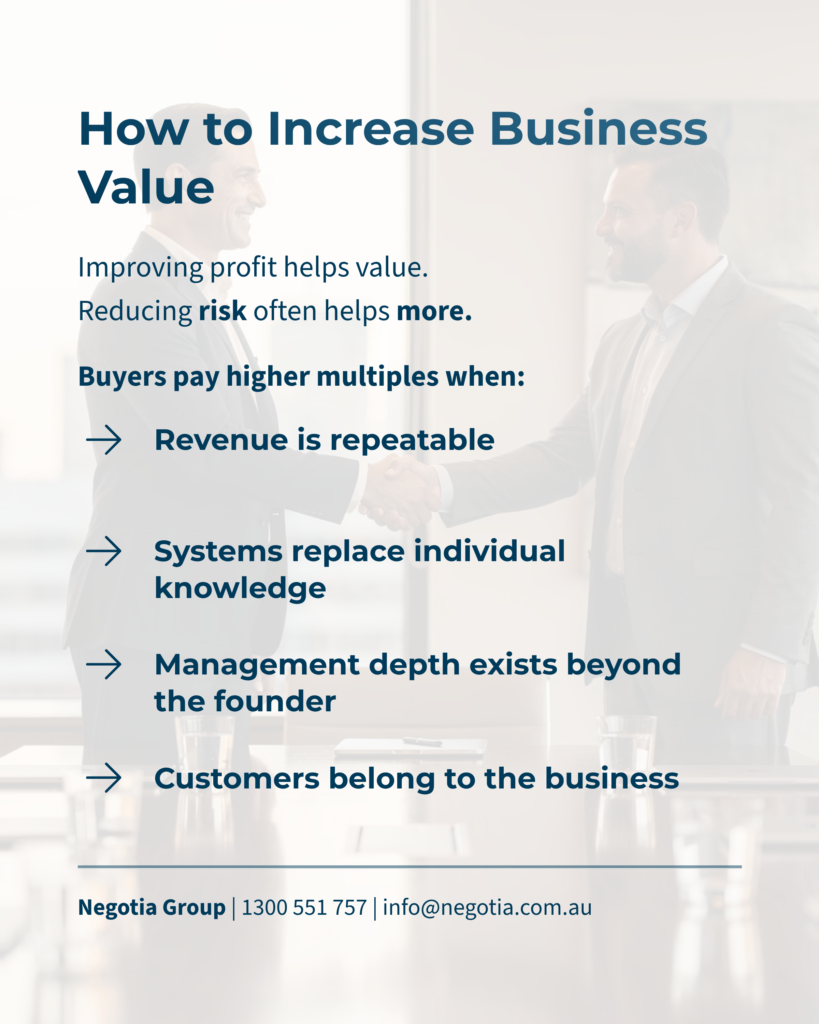
Improving profit will help value.
But reducing risk often helps more.
Buyers pay higher multiples for businesses where:
- revenue comes from multiple sources, is repetitive and is “locked-in”
- management depth exists beyond the founder
- systems replace individual knowledge
- customer relationships belong to the business, not a person
These changes do not just improve operations.
They reduce the risk rate applied to the earnings, and when the risk rate falls, the multiple rises.
Final Thought
Business value is not driven by profit alone.
It is driven by profit adjusted for risk.
That is the part of the equation many owners overlook.
And it is the part buyers examine first.
If you are instructing a valuer or considering a future exit, I am always happy to discuss scope and approach early.